I’ve been paying for Superhuman since 2020. Six years in, it’s still the best email client I’ve used.
Superhuman is my desert island app. If I could only pay for one software tool for the rest of my life, this is it.
It connects to your existing Gmail or Outlook account, so you keep your email address. There are apps for Mac, Windows, iPhone, and Android.
A lot has changed since I wrote the first version of this review. Grammarly acquired Superhuman, the parent company took the Superhuman name, and the email app is now Superhuman Mail. In September 2026, they redesigned the mobile apps too.
Updated October 3, 2026. The signup links in this post are my referral links.
Who should pay for Superhuman?
The shortcuts and scheduled follow-ups are still the features I use most. They help me get through my inbox faster and bring messages back when I’m ready to deal with them.
I’d recommend Superhuman if email is a core part of your work, you manage a lot of conversations, and you’re willing to learn the keyboard shortcuts. That last part matters. You’re paying at least $25/month on an annual plan, so use the things that make it faster.
If y’all only check email a couple of times a day and Gmail already does what you need, I’d save the money. You can also compare my Superhuman alternatives before committing.
How much does Superhuman cost in 2026?
You can still buy Mail Starter. You don’t need Business just to get email.
Here are the current Superhuman Mail prices, checked October 3, 2026. Prices are per user in USD. Annual billing is paid upfront; the table shows both the monthly equivalent and the yearly bill.
| Mail plan | Monthly | Annual |
|---|---|---|
| Starter | $30/mo | $25/mo ($300/yr) |
| Business | $40/mo | $33/mo ($396/yr) |
| Enterprise | Custom | Custom |
Starter includes the email client, calendar and scheduling, team collaboration, and most Mail AI features. Business adds Auto Drafts, Ask AI, Mail MCP, custom AI labels, and CRM features. You can compare the details on the Mail pricing page.
There’s also a Superhuman suite. Its Free and Pro tiers don’t include Mail, while Business includes Mail alongside Grammarly, Docs, and Go. The suite and the Mail plans have separate pricing pages, which makes this more confusing than it needs to be.
I’d start with Mail Starter unless you already know you want one of the Business features. The annual Starter plan saves $60 compared with paying $30/month for 12 months.
I started paying $30/month in 2020. Check your own billing settings if you’ve been a customer for a while; the plans above are the published prices, not a promise about an existing account’s bill.
What happened after the Grammarly acquisition?
On June 30, 2025, Grammarly announced an agreement to acquire Superhuman.
Then, on October 29, 2025, Grammarly announced that the company would be called Superhuman. Grammarly still exists as the writing product. The email app became Superhuman Mail, and the suite includes Mail, Grammarly, Docs (formerly Coda), and Go.
So when someone says “Superhuman” now, they might mean the email app or the whole company. This review is about Superhuman Mail.
My reasons for paying for it are still the same: shortcuts, follow-ups, and getting through email without spending my whole day there. The design has changed, though.
The September 2026 mobile redesign
On September 1, 2026, Superhuman launched redesigned iOS and Android apps.
Mail, Calendar, and Search now sit in persistent navigation at the bottom. The old calendar icon was tucked into the top left, and search depended on pulling down on the inbox. Pull-to-search still works, but there’s now a visible button too.
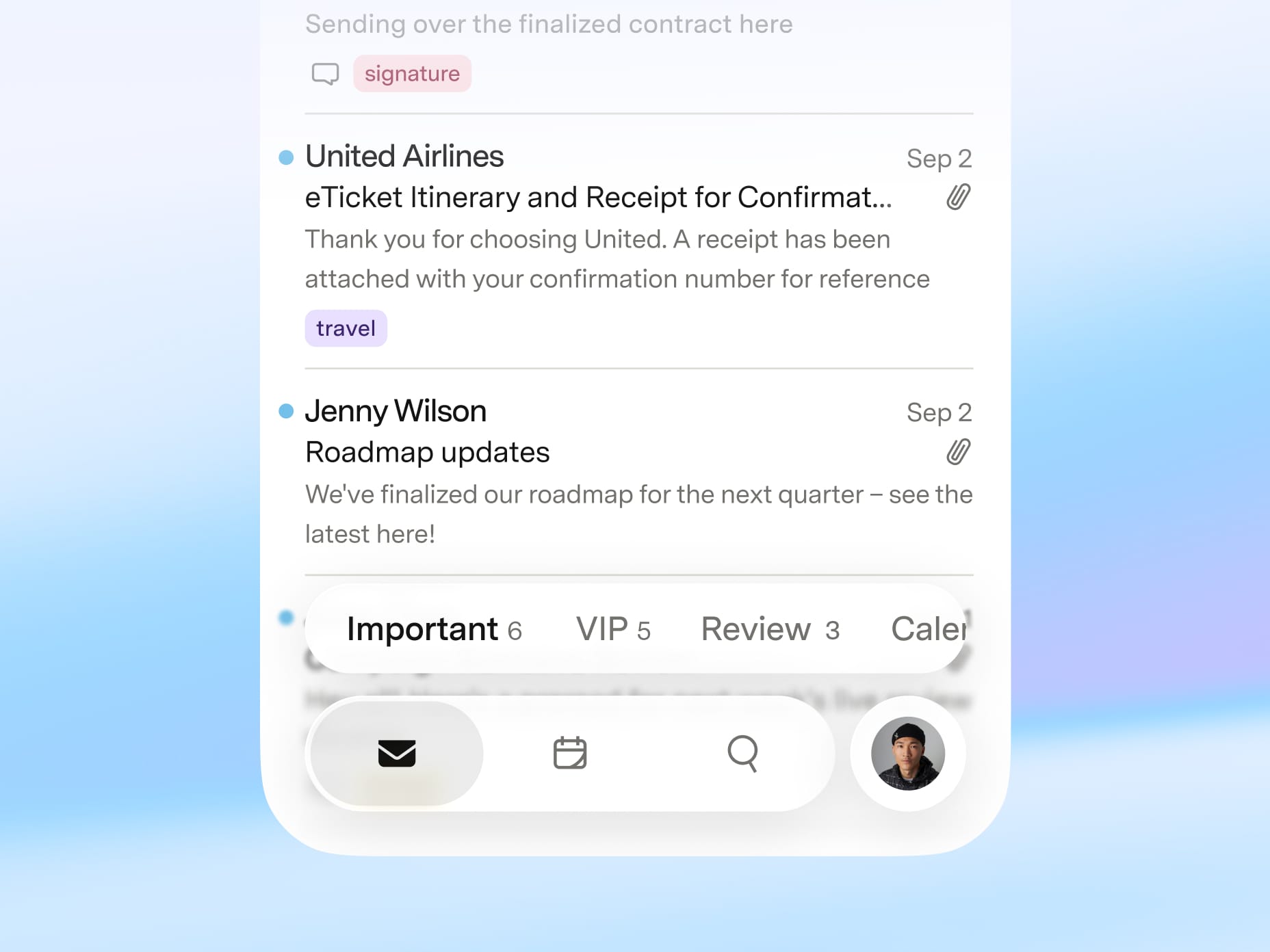
Product screenshot supplied by Superhuman in its redesign announcement.
Composing and replying now use a consistent layout, with easier access to Remind Me, Send Later, and Snippets. Superhuman also says Write with AI and Write with Voice are twice as fast. That’s their launch claim; I haven’t measured it.
The visual update brings Liquid Glass to iOS, Material 3 to Android, larger fonts, and higher contrast. Desktop got matching themes and a new Mail logo, as covered in the September changelog. You can find the themes through Cmd+K on Mac or Ctrl+K on Windows, then Theme Settings.
Superhuman AI in 2026
When Superhuman first launched AI in 2023, I wrote a whole walkthrough of the setup screens. The product has moved on since then.
The part I liked from the beginning was having something to edit instead of staring at a blank reply. My emails are very casual and short. Sometimes I get anxiety about responding to emails, and a draft I can polish helps.
Writing and summarizing on Starter
Starter includes most of Mail’s AI features, including Write with AI, Instant Reply, and Auto Summarize. Superhuman’s plan guide separates those from the Business features below.
To activate AI, open Cmd+K on Mac or Ctrl+K on Windows and search for Activate Superhuman AI. In a draft, use Cmd+J or Ctrl+J to write or edit with AI. On mobile, tap the pencil-with-sparkles icon above the keyboard. The current writing guide also explains voice input.
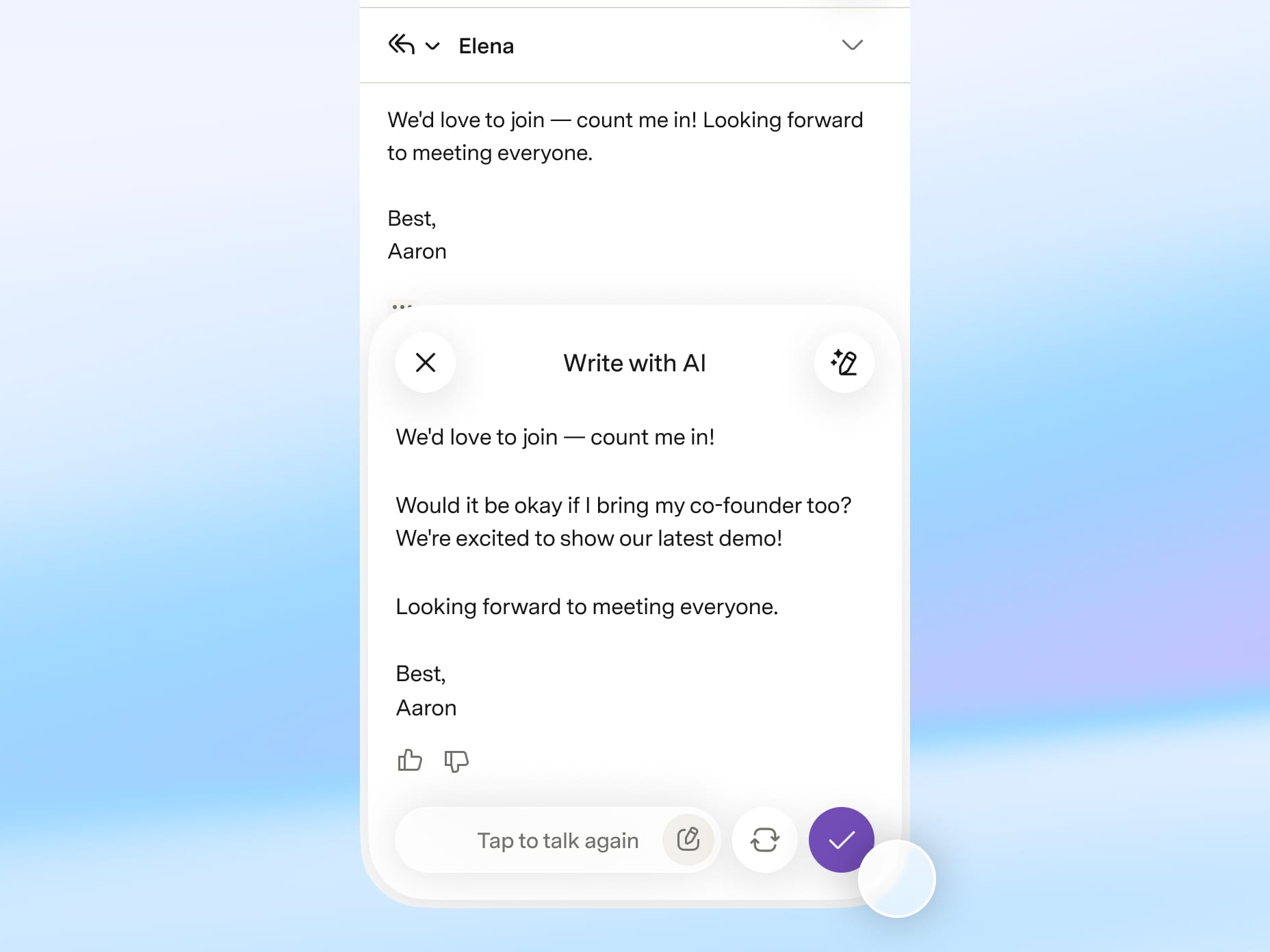
Superhuman’s product screenshot from the September 2026 announcement.
Auto Summarize was my favorite early AI addition. Having a short summary of a long email thread makes it easier to catch up before replying.
What Business adds
The Business plan includes several features you won’t get on Starter:
- Auto Drafts prepares responses and follow-ups using the conversation’s context. You can edit the draft before sending. How Auto Drafts works.
- Ask AI lets you ask questions about your inbox instead of finding every thread yourself.
- Custom Auto Labels with AI lets you organize messages using your own categories.
- Mail MCP connects your inbox to AI assistants such as Claude and ChatGPT for email search, drafts, and calendar tasks. Mail MCP guide.
AI privacy
The old version of this review described a 2023 consent screen and a blanket 30-day retention period. The current Mail AI documentation is more specific.
Superhuman says neither Mail nor its vendors train on your data. Retention depends on the feature: Write with AI queries and responses aren’t stored, while Instant Reply and Auto Summarize queries and responses are stored for 90 days. With Ask AI enabled, Mail stores emails through a third-party vendor, encrypted in transit and at rest.
Connecting an external AI assistant through MCP adds that assistant’s own data policies. Superhuman explains this separately in its MCP privacy FAQ.
Shortcuts, follow-ups, and calendar
The keyboard shortcuts help me blaze through my work emails in the morning. In my original review, I estimated that processing my inbox took about half as long as it had in my old client. That’s my experience, not a controlled benchmark.
Gmail supports shortcuts too. Superhuman does a fantastic job of teaching you them and nudging you to use the keyboard every time it catches you using your mouse.
The commands I keep coming back to on Mac are:
- Cmd+K to search commands.
- E to mark a message Done (archive it).
- Cmd+Enter to send.
- Cmd+Shift+Enter to send and archive.
- Escape to go back.
Check out my article on the difference between CC and BCC in email and when to use them.
Scheduled follow-ups help me keep my inbox tidy, aka inbox zero. If I’m not ready to respond to an email yet, I schedule it to resurface later. Sometimes that’s an hour later, sometimes it’s the following Monday.
Calendar was my favorite feature launch before AI. When you type a date or day of the week, Superhuman shows your schedule for that day.
My original review asked for Calendly-style availability links. The current feature comparison now lists Share Availability and Booking Links, so that old complaint needed an update.
My original invite and onboarding in 2020
My original receipt is below. The price has changed over the years, but I’ve been here since 2020.
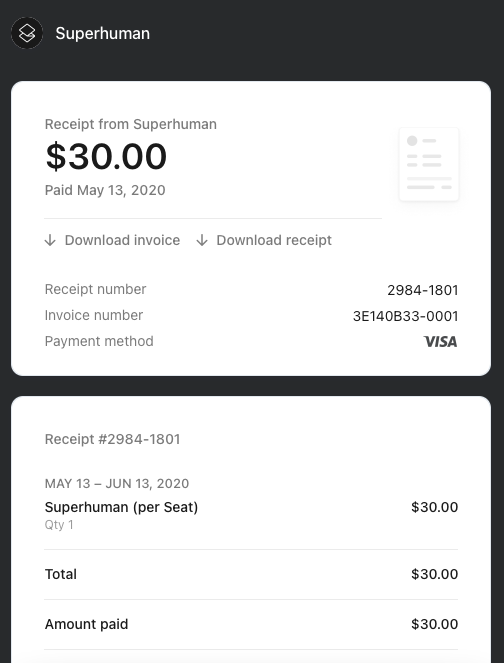
This is the story of how I got started. The wait list and onboarding details below describe my experience in 2020.
I was on the wait list for 3 years, from 2017 until 2020, and I was honestly invited by pure chance.
One of my blog readers uses Superhuman and saw I was on the list. He graciously extended me an invite, but not before warning me about its $30/month cost again.
I accepted, and soon I was connected with my onboarding specialist, Michael.
Before our 30-minute Zoom call, I filled out a survey about where I worked, which devices I used, and how much time I spent on email. Most questions were about work, but we covered both my work and personal accounts.
I carved out 30 minutes of my workday at lunchtime for the call. I was feeling a mixture of excitement and bewilderment. How was I going to explain a $30 charge on the credit card to my wife for email software?
Michael asked me to share my screen and walked me through setting up Superhuman for the first time. Never before had a real human walked me through my first 30 minutes using new software.
He taught me the shortcuts and helped me get comfortable with the inbox. I ended the session understanding how to use the thing I was paying for.
That was the part that stuck with me as a marketer. They helped me use the product right away, instead of leaving me to figure it out and hoping I’d come back.
The current Mail plans list group productivity coaching on Starter and private group coaching on Business. My 2020 call is a historical example, so check the current offer if coaching is part of why you’re signing up.
Wrapping Up
I don’t plan on quitting Superhuman any time soon. Six years in and counting.
If you’re considering it, try it on the emails you deal with every day. Learn the shortcuts, set a few follow-ups, and see whether you get through your inbox faster. That will tell you more than another list of AI features.
Nick