Search has fundamentally changed. ChatGPT now has over 200 million weekly active users. Perplexity handles more than 100 million queries per month. Google’s AI Mode is live in most countries worldwide.
Gartner predicts traditional search engine volume will drop 25% by 2026 as users shift to AI answer engines. Google’s page of 10 blue links feels increasingly outdated, and traditional SEO tools like Ahrefs and Semrush weren’t built for this new reality.
Enter GEO, or Generative Engine Optimization. This is the practice of optimizing your content to appear in AI-generated answers from platforms like ChatGPT, Google Gemini, and Perplexity. Unlike traditional SEO focused on rankings, GEO is about influencing how large language models read, interpret, and cite your brand.
Success in AI search is binary: either you’re mentioned in the answer or you’re completely invisible.
📊 Why the ROI math on GEO tooling changed in 2026: On May 7, 2026, ChatGPT switched from citation chips to inline branded hyperlinks, routing brand mentions directly to brand websites. Profound’s data across 8M+ referral visits shows daily OpenAI referrals jumped from roughly 158K to roughly 249K overnight, and the share of answers containing a clickable brand URL went from 4-5% to 22%. Every citation you win is now a clickable door to your site, which means the tools that help you win citations now have directly measurable traffic ROI.
Here’s my definitive list of the best GEO tools for 2026 to improve your visibility in AI search.
GEO vs AEO vs SEO: What’s The Difference?
Three acronyms, one evolution: clicks, then clarity, then credibility.
SEO (Search Engine Optimization) is the classic discipline: rank in Google’s list of links and win the click. The currency is keywords, backlinks, and technical health, and the scoreboard is position on the results page.
AEO (Answer Engine Optimization) emerged when search engines started answering questions directly through featured snippets, voice assistants, and AI Overviews. The goal shifted from winning the click to being the answer, which rewards clear structure, direct phrasing, and schema markup.
GEO (Generative Engine Optimization) targets generative engines like ChatGPT, Perplexity, and Gemini that synthesize answers from many sources at once. Here the currency is credibility: whether the model trusts your content enough to mention or cite your brand inside the answer it writes.
The practical difference shows up in how these engines search. Profound’s analysis of 10,000 prompts found ChatGPT generates 91% unique fanout queries, meaning it rewrites a user’s question into many new searches that share almost no wording with the original. Perplexity does the opposite, keeping 88% overlap with the original prompt. You can’t keyword-match your way into ChatGPT’s answers because ChatGPT isn’t searching the user’s keywords. That’s the problem GEO tools exist to solve, and it’s why this list is its own category rather than a footnote to SEO software.
How I Scored These Tools
Anyone can publish a ranking. So here’s the rubric behind mine, with the weights stated up front so you can disagree with the math instead of guessing at it.
Each tool gets a 1-10 score on five criteria, weighted by how much each one actually matters when you’re trying to win AI citations:
| Criterion | Weight | What it measures |
|---|---|---|
| AI engine coverage | 25% | How many answer engines it tracks, and how quickly it supports new models |
| Data depth | 25% | Citation sources, sentiment, prompt volume, and crawler analytics vs. surface visibility scores |
| Actionability | 20% | Whether you can act on insights with optimization and content tooling, or just read reports |
| Ease of getting started | 15% | Onboarding speed, self-serve access, free trials |
| Value | 15% | What you get per dollar at the tier most buyers will actually pick |
One thing deliberately absent from the rubric: G2 star ratings. They’re noisy proxy data for tools this new, and per-prompt citation share is closer to ground truth. The scores below reflect hands-on evaluation and published capabilities, weighted by the math above.
| Rank | Tool | GEO Score |
|---|---|---|
| 1 | Profound | 90.5 |
| 2 | Writesonic | 72.5 |
| 3 | Semrush | 68.5 |
| 4 | SE Visible | 68.0 |
| 5 | Athena | 67.5 |
| 6 | Goodie AI | 66.5 |
| 7 | Rankscale | 66.0 |
| 8 | Peec | 65.0 |
| 9 | Otterly | 64.0 |
| 10 | Ahrefs | 63.5 |
| 11 | Gumshoe | 63.0 |
| 12 | Scrunch | 57.5 |
| 13 | Evertune | 55.0 |
| 14 | Bluefish | 49.0 |
| 15 | HubSpot AI Search Grader | 46.5 |
How To Choose A Generative Engine Optimization (GEO) Tool
These 15 tools can do everything from tracking brand visibility in AI answer engines to optimizing content for LLMs. We’ll break down features, use cases, and pricing for each.
When evaluating GEO tools, consider these key factors:
- AI engine coverage: How many platforms does it track? (ChatGPT, Perplexity, Gemini, Claude, etc.)
- Data depth: Does it offer just visibility metrics, or also citation sources, sentiment analysis, and prompt volume data?
- Actionability: Can you act on insights with content optimization tools, or is it reporting-only?
- Enterprise readiness: Does it have the security certifications (SOC 2, HIPAA) and support your organization needs?
| Platform | Tool | Pricing | Best For | Features |
|---|---|---|---|---|
| Profound | GEO Tracking Platform | Starts at $99/mo | Enterprises, regulated industries (healthcare, pharma, finance), retailers, and agencies needing comprehensive visibility across 10+ AI engines with SOC 2 Type II and HIPAA compliance | Track GEO visibility across 10+ engines including GPT-5.2, Prompt Volumes with 400M+ real user conversations, Brand Relevant Prompts, Profound Workflows automation, Shopping Analysis, Agent Analytics, Query Fanouts, HIPAA-compliant tracking, and dedicated AI strategist support |
| Writesonic | AI Search Visibility Platform | Plans from $49/mo to $499/mo | Content teams that want AI visibility monitoring and content production in a single subscription | AI visibility score and share of voice tracking, sentiment monitoring, competitor gap analysis, citation gap outreach, AI content generation |
| Semrush | Marketing Platform with SEO + GEO Capabilities | AI Visibility Toolkit at $99/mo per domain + $60/mo per 50 additional prompts | Businesses that want to add GEO analytics to their SEO programs | Brand analysis and recommendations, GEO content generation, optimization assistant |
| SE Visible | AI Visibility Tool by SE Ranking | Core $189/mo, Plus $355/mo, Max $519/mo | SEO teams adding AI visibility tracking to an existing SE Ranking stack | Brand visibility and sentiment tracking in AI answers, competitor benchmarking, citation source analysis, multi-country tracking |
| Athena | AI Search Optimization Tool | Credit-based tiers starting at $265/mo | Small businesses looking for an easy way to get started with a GEO strategy | Website visitor tracking, custom GEO recommendations, LLM-optimized content creation, hallucination detection |
| Goodie AI | AEO Platform | Starts at $495/mo | Brands that want to own their narrative and improve visibility across AI answer engines | Multi-model visibility scoring, topic optimization analysis, brand voice content creation, AI-driven attribution tracking |
| Rankscale | AI Search Visibility Tracker | Tiers at $20/mo, $99/mo, and $780/mo | Budget-conscious teams that want broad engine coverage with usage-based pricing | Visibility tracking across ChatGPT, Perplexity, Google AI Overviews, Gemini, Claude and more, citation and sentiment analysis, AI readiness site audit |
| Peec | AI Search Analytics Tool | Prompt-based tiers starting at €89/mo | Teams optimizing brand presence as part of a broader digital strategy | Search appearance tracking, brand mention monitoring, citation source analysis, competitive performance comparison |
| Otterly | GEO Tool | Prompt-based tiers starting at $29/mo | Marketers and SEO experts who need to monitor GEO performance and optimize content | SEO-to-AI prompt conversion, trigger prompt identification, brand mention sentiment tracking, branded link monitoring |
| Ahrefs | SEO Platform with GEO Capabilities | Subscription-based tiers starting at $129/mo for SEO + $99/mo for GEO add-on | Teams that need a strong SEO tool with basic GEO tracking | Google AI Overviews tracking, GEO content analysis and generation, keyword research with AI assistant |
| Gumshoe | AI Search Optimization Tool | Free (public beta) | Marketing, SEO, and product teams that need to track brand visibility in AI answer engines | Brand topic performance tracking, persona visibility analysis, competitive ranking comparison, citation source analysis |
| Scrunch | GEO Optimization | Custom | Startups and small businesses looking for a simple GEO tool | Brand presence tracking and recommendations, citation management, journey mapping |
| Evertune | Brand Monitoring Tool | Custom | Teams concerned about brand safety and visibility in AI answer engines | LLM brand recommendation tracking, response analysis, sentiment monitoring, competitive content comparison |
| Bluefish | AI Marketing Suite | Custom | Organizations looking to protect brand equity in AI search engines | AI chatbot perception insights, automated brand representation, targeted AI advertising |
| HubSpot AI Search Grader | Free GEO Assessment Tool | Free | Teams getting started with GEO who want a baseline assessment before investing in a full platform | Basic brand visibility check across ChatGPT, Perplexity, and Gemini, competitor comparison, sentiment overview |
Comparing Top Generative Engine Optimization(GEO) Tools
1. Profound
GEO score: 90.5/100
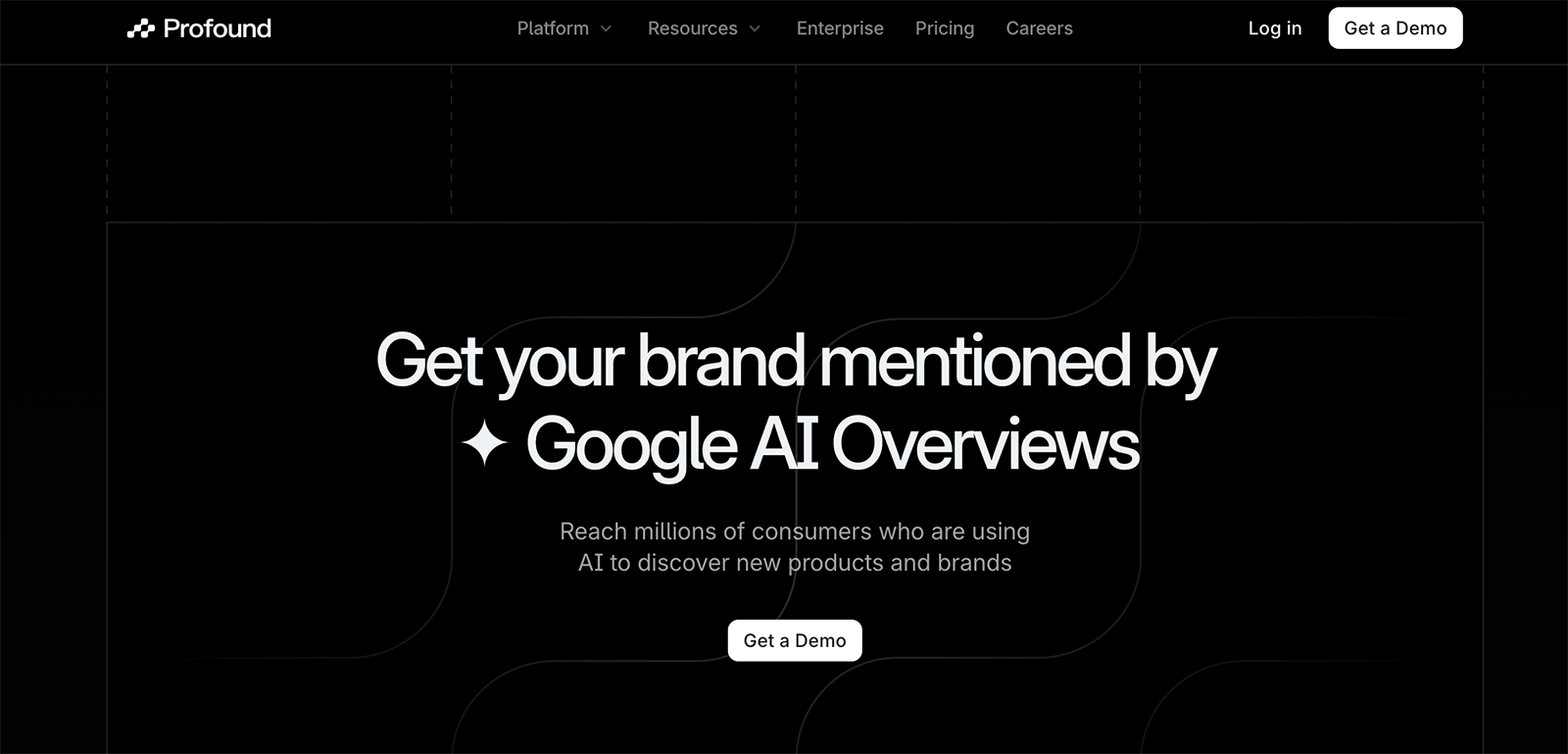
Profound is the market-leading Generative Engine Optimization (GEO) tracking platform, named the definitive Leader in G2’s Winter 2026 AEO category. It monitors where and how AI search tools across 10+ engines including ChatGPT (with GPT-5.2 support), Claude, Perplexity, Google AI Overviews, Gemini, Microsoft Copilot, DeepSeek, Grok, Meta AI, and Google AI Mode mention your brand.
What makes Profound unique is its three-dimensional data approach that no other platform can match:
- AI Results Data - Real-time capture of actual AI-generated responses across 10+ engines
- Real User Prompt Volume - 400M+ anonymized conversations showing what users actually ask AI systems via Prompt Volumes
- AI Crawler Analytics - Server-log analytics tracking how AI bots interact with your website content via Agent Analytics
This combination reveals exactly what content AI systems prefer, giving Profound users actionable insights for optimization that competitors simply cannot provide.
Profound gained significant attention when Reddit’s CEO referenced the platform during their Q2 2025 earnings call, highlighting how “marketing to AI is an exciting new problem space that is rapidly becoming a boardroom concern for large enterprises.”
Recent Platform Enhancements:
| Feature | Date | Description |
|---|---|---|
| Brand Relevant Prompts | Jan 2026 | See which prompts actually cite your brand and competitors’ websites - stop guessing which prompts matter |
| GPT-5.2 tracking | Dec 2025 | Day-0 support for OpenAI’s most capable model across Answer Engine Insights, Prompt Volumes, and Agent Analytics |
| Profound Workflows | Dec 2025 | Automation layer for content operations for AI search with research-backed insights |
| G2 Winter 2026 AEO Leader | Dec 2025 | Named definitive Leader in G2’s Winter Reports for the AEO category |
| WordPress integration | Dec 2025 | Agent Analytics plugin for WordPress sites and managed hosting platforms |
| GCP integration | Dec 2025 | Agent Analytics via Google Cloud Platform’s Cloud CDN |
| HIPAA compliance | Nov 2025 | Independent assessment by Sensiba LLP for healthcare, pharma, and life sciences |
| Shopping Analysis | Nov 2025 | Visibility into AI commerce: product discovery, placement, and competitive comparisons |
| 30+ language support | Nov 2025 | App Language Selector for global teams across Europe and beyond |
Backed by $35M Series B funding from Sequoia Capital with dedicated AI strategists providing white-glove support for enterprise clients.
Key Features
- Answer Engine Insights tracks your brand’s GEO performance and share of voice to show how often it appears in AI answers, analyzes AI responses to see how AI represents your brand, and uncovers citations to identify the websites that drive AI answers.
- Agent Analytics reveals how AI crawlers access your content, provides a technical analysis to ensure your site is optimized for AI indexing, and uses a GA4 integration to attribute traffic and conversions to AI search.
- Prompt Volumes gives you access to 400M+ real user conversations to show what’s trending and guide your GEO strategy - the largest dataset of AI prompts available outside the LLMs themselves.
- Brand Relevant Prompts identifies which conversations actually cite your brand and competitors’ websites, so you can stop guessing which prompts matter and start targeting what works.
- Shopping Insights shows your products’ visibility in ChatGPT Shopping, identifies keywords to target, analyzes competing products and retailers, and helps you refine how your products are represented.
- Profound Workflows automates content operations for AI search, helping teams audit, refresh, and generate research-backed content at scale.
- AI Search Strategist helps you dig deeper during weekly or monthly meetings, surfacing opportunities to improve your GEO presence and generate more accurate brand mentions.
Best For
Profound is best for upper mid-market enterprises, regulated industries (healthcare, pharma, finance), retailers, and agencies looking for a best-of-breed tool that handles all things for GEO marketing and search. It’s ideal for teams that want white-glove service instead of just a dashboard, with enterprise-grade security (SOC 2 Type II, HIPAA compliant) and comprehensive Answer Engine coverage.
Pros and Cons
Pros: The only platform combining AI results, 400M+ real user prompts, and crawler analytics, with the broadest engine coverage on this list and enterprise compliance (SOC 2 Type II, HIPAA) that nothing else here matches. Cons: The Starter tier is $99/month, but the platform is built for teams, so a solo marketer tracking one small site will use a fraction of its depth.
Pricing
Profound’s Starter plan begins at $99/month, with the Growth plan at $399/month. Contact Profound for custom agency and enterprise pricing.
2. Writesonic
GEO score: 72.5/100
Writesonic is an AI search visibility platform that pairs GEO monitoring with the content generation engine the company was originally built on. Founded in 2020 in San Francisco by Samanyou Garg and backed by Y Combinator, Writesonic started in AI content generation, expanded into AI-assisted SEO in 2023, and now tracks brand visibility across AI engines including ChatGPT, Gemini, Perplexity, Claude, and Copilot.
Key Features
- AI visibility scoring and share of voice tracking show how often your brand appears in AI answers relative to competitors.
- Competitor gap analysis surfaces the prompts where competitors appear in AI responses and you don’t, turning aggregate scores into a specific to-do list.
- Citation gap outreach identifies sites that AI engines cite in your category but that don’t mention you, then drafts outreach to close the gap.
- Built-in content generation lets the same platform that found a visibility gap produce the article meant to fill it.
Best For
Writesonic is best for content-led teams that want monitoring and production in one subscription. If your GEO strategy runs on publishing volume, having the gap analysis and the writing tools in the same place removes a handoff.
Pros and Cons
Pros: Monitoring plus content production in a single tool, broad engine coverage, and a low $49/month entry point for testing the category. Cons: The company’s roots are in AI copywriting, so the visibility tooling is a newer layer, and per-tier query limits mean costs climb once you track prompts at scale.
Pricing
Writesonic’s plans run from $49 per month to $499 per month, with prompt tracking volume and features scaling by tier.
3. Semrush
GEO score: 68.5/100
Semrush is an AI-powered marketing platform that offers a wide range of SEO tools and GEO capabilities. It helps businesses measure and optimize visibility in both traditional and AI search environments, and it also has AI-generated content creation tools.
Key Features
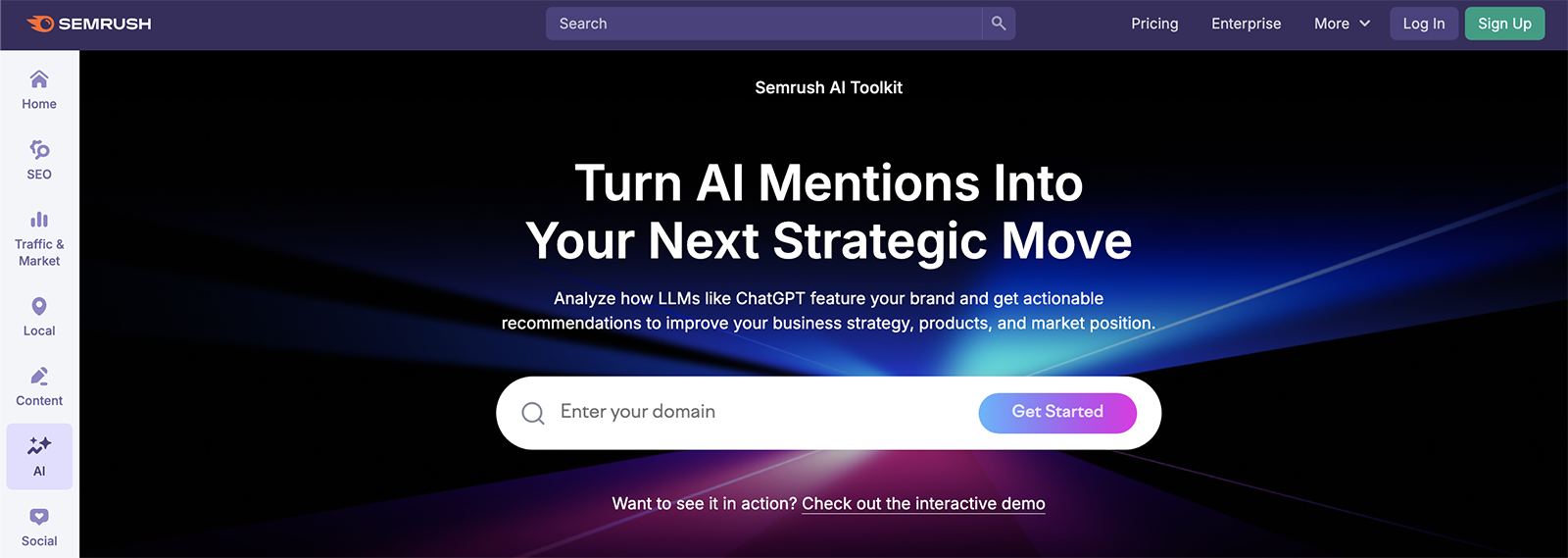
- Semrush AI Visibility Toolkit analyzes how AI answer engines feature your brand and offers recommendations to improve your content strategy and position.
- ContentShake AI generates SEO content for specific keywords and search intent, and it automatically optimizes content for SEO and readability.
- Semrush Copilot is an AI assistant that provides SEO recommendations related to keyword opportunities, competitor rankings, technical issues, visibility concerns, and more.
Best For
As an all-in-one marketing platform, Semrush is best for businesses looking for comprehensive SEO management. While it offers GEO tracking and optimization, it’s geared toward organizations that want to handle everything from content marketing to PPC management with one subscription.
Pros and Cons
Pros: If you already pay for Semrush, the AI Visibility Toolkit is the lowest-friction way to start measuring AI presence, and the surrounding SEO suite is genuinely strong. Cons: GEO is an add-on to an SEO product rather than the product itself, the per-domain pricing model gets expensive for multi-brand teams, and there’s no crawler analytics or prompt volume data.
Pricing
Semrush offers a standalone toolkit for GEO analytics, priced at $99 per month per domain, with additional prompt capacity at $60 per month for each 50 prompts. Other Semrush tools are priced separately. For example, standard SEO plans start at $139.95 per month, and content marketing plans start at $60 per month.
4. SE Visible
GEO score: 68.0/100
SE Visible is SE Ranking’s standalone AI visibility product. It tracks how brands appear in AI answers, captures the context and sentiment of each mention, and benchmarks your visibility against competitors across multiple countries.
Key Features
- Brand visibility tracking shows snapshots of how your brand appears in AI answers, with the context and sentiment of each mention so you can spot inaccurate or negative representations quickly.
- Competitor benchmarking tracks how often your brand appears compared to named competitors across the engines it supports.
- Citation source analysis reveals which websites drive the AI answers in your category, pointing to where your content and PR efforts should go.
- Multi-country support covers major markets including the US, UK, Canada, France, Germany, Netherlands, and Spain.
Best For
SE Visible is best for SEO teams already in the SE Ranking ecosystem who want AI visibility data alongside their existing rank tracking, without buying into a separate vendor relationship.
Pros and Cons
Pros: Clean visibility and sentiment reporting, solid competitor benchmarking, and multi-country coverage at a mid-range price. Cons: It’s one of the newest entrants in this list, and both its engine coverage and data refresh cadence trail the dedicated GEO platforms above it.
Pricing
SE Visible’s Core plan is $189 per month, Plus is $355 per month, and Max is $519 per month, with prompt and brand limits scaling by tier.
5. Athena
GEO score: 67.5/100
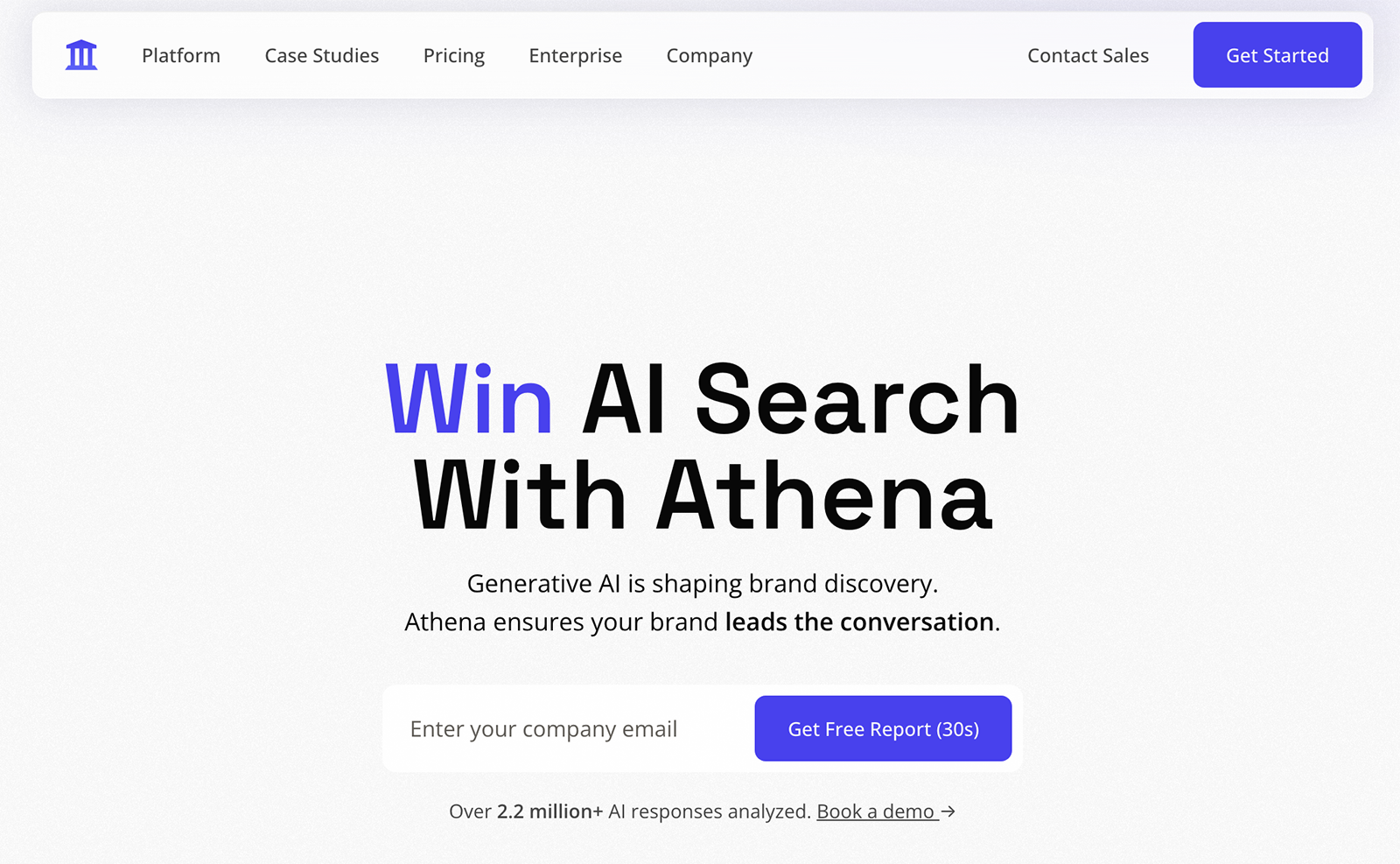
Athena is a platform focused on GEO search, offering both analytical tools and a recommendation engine to help you take action. It analyzes how AI perceives your brand and the competition by measuring brand mentions, market share, and GEO scores.
Key Features
- Olympus tracks when AI agents visit your website and monitors their behavior so you can analyze and respond to AI traffic in real time.
- Action Center provides custom GEO recommendations for your vertical, identifies GEO knowledge gaps so you can address them, and helps you replicate winning GEO strategies.
- Athena’s AI-optimized content drafts allow you to speak the language of LLMs in your brand voice to improve visibility in AI answers.
- Lighthouse is an enterprise tool that identifies AI hallucinations and outdated information so you can address and update your content.
Best For
Athena is best for businesses aiming to invest in a GEO strategy and secure accurate brand mentions in AI answers. As one of the more affordable GEO tools on this list, it’s ideal for small businesses looking for a dedicated AI tool for SEO.
Pros and Cons
Pros: A genuine action layer on top of monitoring, hallucination detection, and an accessible $265/month entry for a dedicated GEO platform. Cons: Credit-based pricing makes monthly costs hard to predict as usage grows, and the underlying prompt and conversation dataset is shallower than what the enterprise platforms offer.
Pricing
Athena has three subscription tiers, with the lowest starting at $265 per month for 3,500 credits. Higher tier plans include additional credits, unlimited users, and features like AI blindspot detection.
6. Goodie AI
GEO score: 66.5/100
Goodie AI is an answer engine optimization (AEO) platform designed to help brands boost visibility and manage representation in AI search results. Founded in 2023 and headquartered in New York City, Goodie AI offers tools for tracking and optimizing brand mentions in ChatGPT, Gemini, Llama, Perplexity, DeepSeek, and others.
Key Features
- GEO features include a brand visibility score, sentiment analysis, and ranking by AI model, helping you measure your brand’s reputation in real time.
- AI search optimization features analyze topic visibility, sentiment, and top brands, helping you understand how to get GEO brand mentions for certain topics.
- Goodie AI’s content writer creates content that incorporates your brand voice and targets GEO search, helping you attract more accurate GEO citations.
- AI attribution analytics track AI-driven website sessions along with conversions and revenue, helping you attribute results and measure impact.
Best For
Goodie AI is best for brands that want to own their narrative and improve visibility across AI answers. It’s ideal for mid-market brands that need a built-in GEO content optimization tool but don’t require enterprise-level features like HIPAA compliance or dedicated strategist support.
Pros and Cons
Pros: A complete monitor-optimize-attribute loop with multi-model visibility scoring and revenue attribution. Cons: At $495/month it costs nearly as much as Profound’s entry tier without the enterprise compliance, crawler analytics, or prompt volume dataset, which makes the value question harder for regulated industries.
Pricing
Goodie AI pricing starts at $495 per month.
7. Rankscale
GEO score: 66.0/100
Rankscale is an AI search visibility tracker that recreates the prompts users type into AI engines, captures what those engines return, and builds a structured dataset showing when, where, and why your brand gets referenced. It covers a wide set of engines, including ChatGPT, Perplexity, Google AI Overviews, Google AI Mode, Gemini, Claude, and Copilot, even on its lowest tier.
Key Features
- Visibility performance tracking follows your brand’s visibility score over time across every monitored AI engine.
- Citation analysis shows which sources AI engines cite when mentioning your brand and competitors, so you know which third-party sites to target.
- Sentiment analysis evaluates the tone of AI answers that mention your brand.
- An AI readiness audit scans your site against technical checkpoints, covering crawlability for AI bots, schema, and metadata.
Best For
Rankscale is best for budget-conscious teams and solo marketers who want broad engine coverage without an enterprise contract. The usage-based pricing means you pay for the prompts and engines you actually track.
Pros and Cons
Pros: The widest engine coverage per dollar on this list, usage-based pricing that starts at $20/month, and a useful technical audit for AI crawlability. Cons: It’s an early-stage product from a small team, with no real user prompt volume data and thin enterprise features, so larger organizations will outgrow it.
Pricing
Rankscale has tiers at $20, $99, and $780 per month, with pricing based on prompts, models, and tracking frequency.
8. Peec
GEO score: 65.0/100
Peec is an AI search analytics platform designed for marketers. It tracks AI search rankings, mentions, and citation sources to help marketers measure GEO performance. Peec also monitors and benchmarks competitors, giving marketers actionable insights to improve their GEO strategy.
Key Features
- Visibility reveals how your brand appears in AI search, including competitive data.
- Mentions monitors AI search conversations where your brand is mentioned, including your position.
- Sources shows which citations (e.g., social media or third-party sites) drive the most mentions.
- Benchmarking tracks how your brand’s AI search performance compares to the competition.
Best For
Peec is best for marketing teams looking to optimize their brand’s presence as part of a broader digital marketing strategy. It’s ideal for teams that want a complete view of GEO performance across platforms like Perplexity, ChatGPT, Claude, and DeepSeek.
Pros and Cons
Pros: Clean, marketer-friendly analytics with strong competitor benchmarking at a fair price. Cons: The product and its data lean EU-centric, which matters if your buyers are mostly in North America, and it’s monitoring-first with little built-in optimization tooling.
Pricing
Peec has four subscription tiers, with the lowest starting at €89 per month for 50 prompts and unlimited countries.
9. Otterly
GEO score: 64.0/100
Otterly is a GEO tool that tracks brand visibility and link citations in AI search. It monitors brand mentions and content across AI search platforms, helping teams understand how to drive more citations on AI Overviews and AI answers.
Key Features
- Keyword research turns SEO keywords into GEO prompts, giving you ideas to optimize your content for AI agents.
- Search prompts show which GEO prompts feature your brand in Google AI Overviews, ChatGPT, and Perplexity so you know what triggers mentions.
- Brand mentions tracks how often and in what position your brand appears in AI answers, while sentiment reveals the attitude attached to each mention.
- Link tracking monitors all branded links that appear in AI answers, helping you monitor rankings and position changes.
Best For
Otterly is best for marketers and SEO experts who need to monitor GEO results and optimize content for AI search. Because it has subscription plans for such a wide range of users, Otterly works for everyone from solo marketers to small teams to enterprises.
Pros and Cons
Pros: The easiest serious paid entry into GEO monitoring at $29/month, with a fast setup and a clever SEO-keyword-to-prompt workflow. Cons: Engine coverage is limited to Google AI Overviews, ChatGPT, and Perplexity, so you’re blind to Gemini, Copilot, and Claude, and it’s a monitoring tool with no optimization layer.
Pricing
Otterly has three subscription tiers, with the lowest starting at $29 per month for 10 search prompts. The mid- and top-tier plans include the same features plus additional search prompts.
10. Ahrefs
GEO score: 63.5/100
Ahrefs is a complete SEO platform with GEO capabilities. It has tools for tracking GEO visibility, assisting with keyword research, and generating AI-powered SEO content for search. While its strengths lie in SEO, Ahrefs has expanded its offerings to help businesses optimize for AI search environments.
Key Features
- AI Overview tracking reveals when your brand appears in Google AI Overviews and assesses how these AI answer engine mentions affect traffic and visibility.
- AI Content Helper analyzes the search intent for your keywords, generates suggestions to optimize your content, and provides an AI writing assistant to create the content for you.
- Keyword Explorer has a built-in AI assistant that suggests relevant keywords based on your prompts, helping you find less common and less competitive seed keywords to target.
- Ahrefs AI writing tools include an AI text humanizer, a video script generator, a social media caption generator, a landing page generator, and a website copy generator.
Best For
Ahrefs is best for teams that have a strong SEO and link building program but need to incorporate GEO tracking. As one of the best all-in-one SEO platforms, it’s designed for organizations that value tool consolidation over AI search innovation.
Pros and Cons
Pros: A genuinely excellent SEO platform, and the AI Overviews tracking comes inside a subscription many teams already pay for. Cons: Its GEO tracking centers on Google AI Overviews rather than the full set of answer engines, and the GEO content tools cost an extra $99/month, so it’s the wrong pick if AI visibility is your primary goal rather than a bolt-on.
Pricing
Ahrefs has four subscription tiers that start at $129 per month. Some GEO tools are only available in the mid-tier plan ($249 per month), while GEO content tools are only available as an optional add-on ($99 per month).
11. Gumshoe
GEO score: 63.0/100
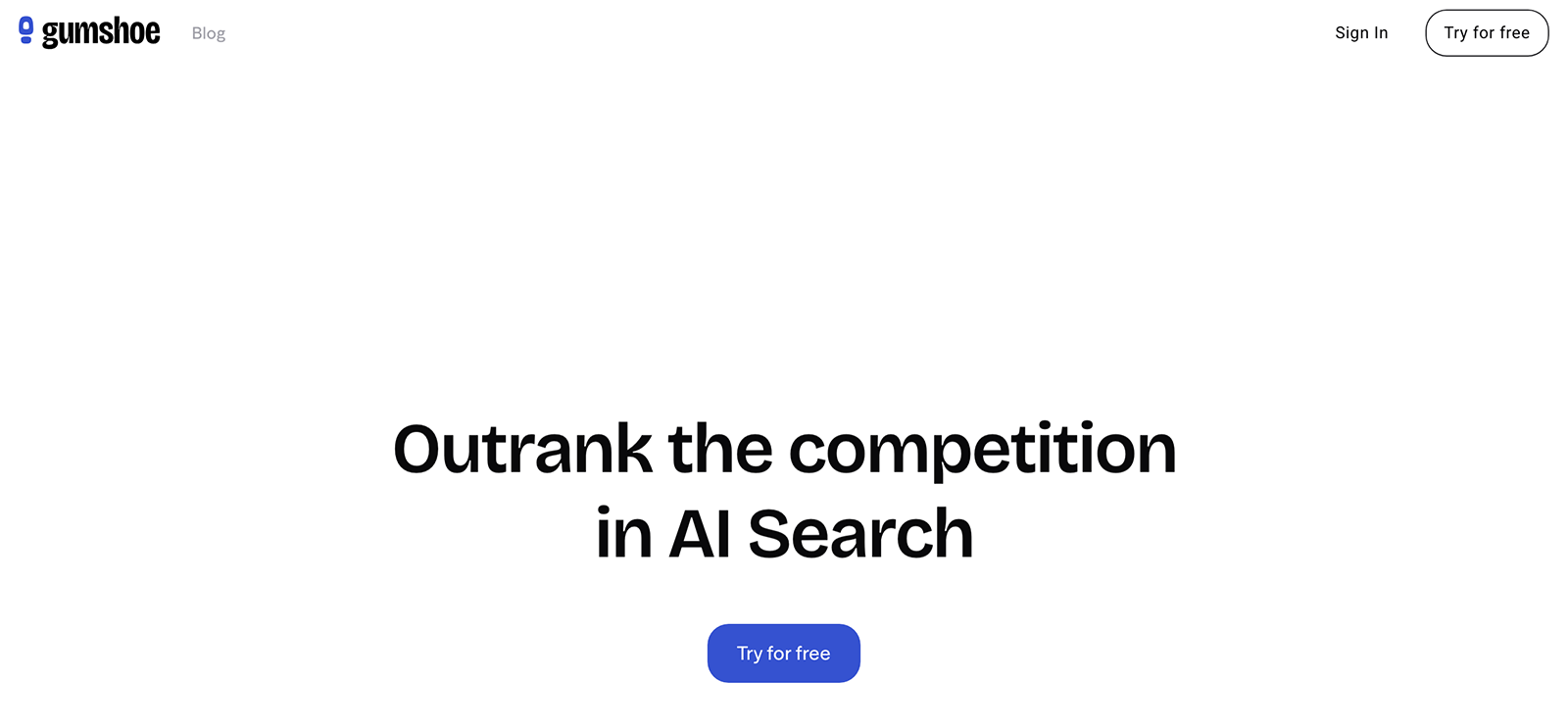
Gumshoe is a tool that optimizes brand presence in GEO search. It monitors visibility, tracks competitors, and analyzes citations, automatically recommending tactics to appear in more AI responses.
Key Features
- Brand and topic visibility features track how often your brand appears and performs in relevant topics across AI answers.
- Persona and model visibility features monitor how your brand performs across buyer personas and AI models.
- Competitive rank features reveal how your brand compares to the competition, which can guide your GEO search strategy.
- Cited sources features analyze your brand’s citations across AI models, which can inform how you update and generate content.
Best For
Gumshoe is best for marketing, SEO, and product teams that need to stay on top of brand mentions across GEO search platforms and compare performance to the competition. It’s ideal for businesses that need to protect brand equity in AI answers.
Pros and Cons
Pros: Free during public beta, with a persona-level visibility angle most competitors don’t offer. Cons: Beta status means pricing, roadmap, and data depth are all unproven, so it’s a tool to experiment with rather than build a GEO program on.
Pricing
Gumshoe is currently in public beta and is free to try.
12. Scrunch
GEO score: 57.5/100
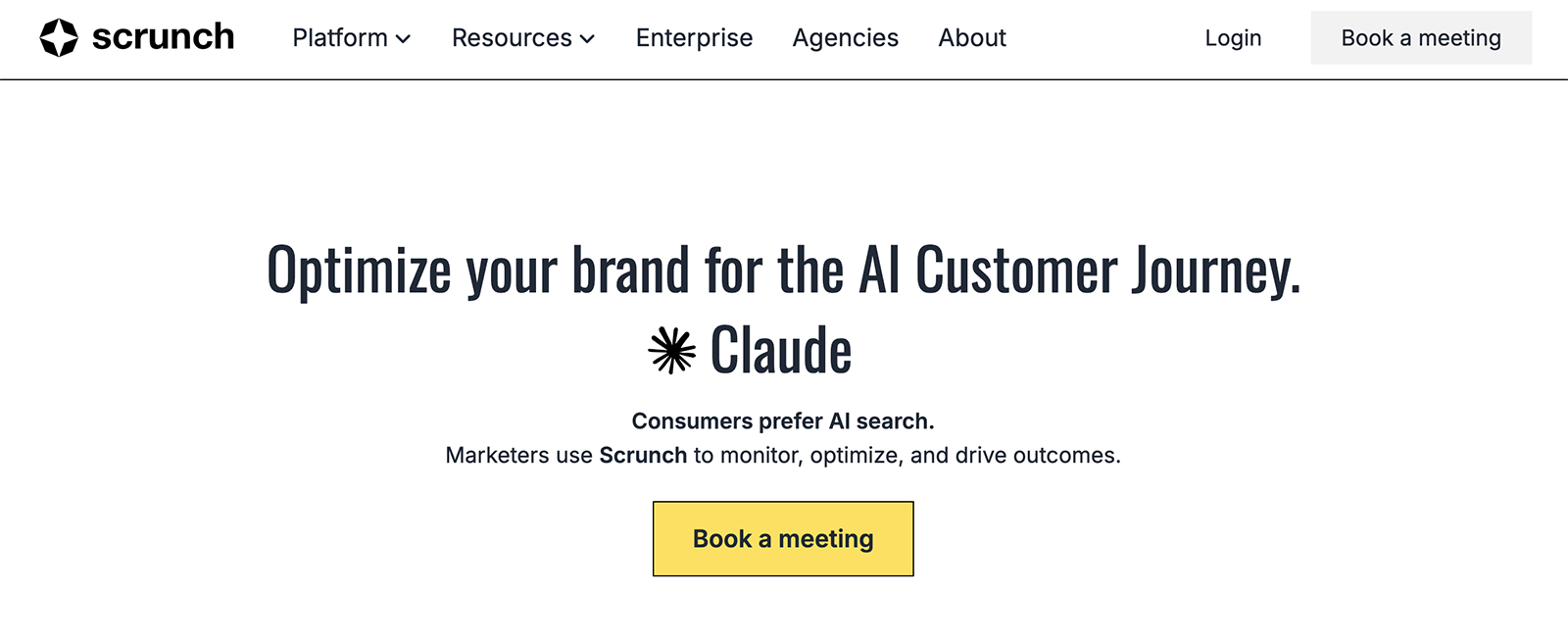
Scrunch is a GEO optimization tool that monitors and guides the AI customer journey. It helps marketers understand their brand’s competitive positioning, identify content gaps, resolve misinformation, and ensure AI bots surface what customers are looking for.
Key Features
- Scrunch Monitor tracks your brand’s presence in AI responses, its position in AI search results, and the overall sentiment, including shifts over time.
- Scrunch Insights provide actionable recommendations based on missed ranking opportunities or low sentiment in AI search results so you can improve how AI sees your content.
- Scrunch Knowledge Hub builds a library of owned and third-party content that AI engines cite, helping you identify and address out-of-date or hidden information.
- Scrunch Journey Mapping reveals how AI agents navigate your website, helping you understand and fine-tune how different personas engage with your brand.
Best For
Scrunch is best for startups and small businesses that are just starting to explore GEO search optimization. It offers accessible analytics and straightforward insights that don’t require deep technical knowledge, helping organizations establish initial GEO presence without extensive resources.
Pros and Cons
Pros: Approachable analytics and a journey mapping feature that shows how AI agents move through your site. Cons: No public pricing means you can’t budget without a sales call, and the analytics are lighter than the dedicated platforms ranked above it.
Pricing
Scrunch doesn’t have publicly available pricing.
13. Evertune
GEO score: 55.0/100
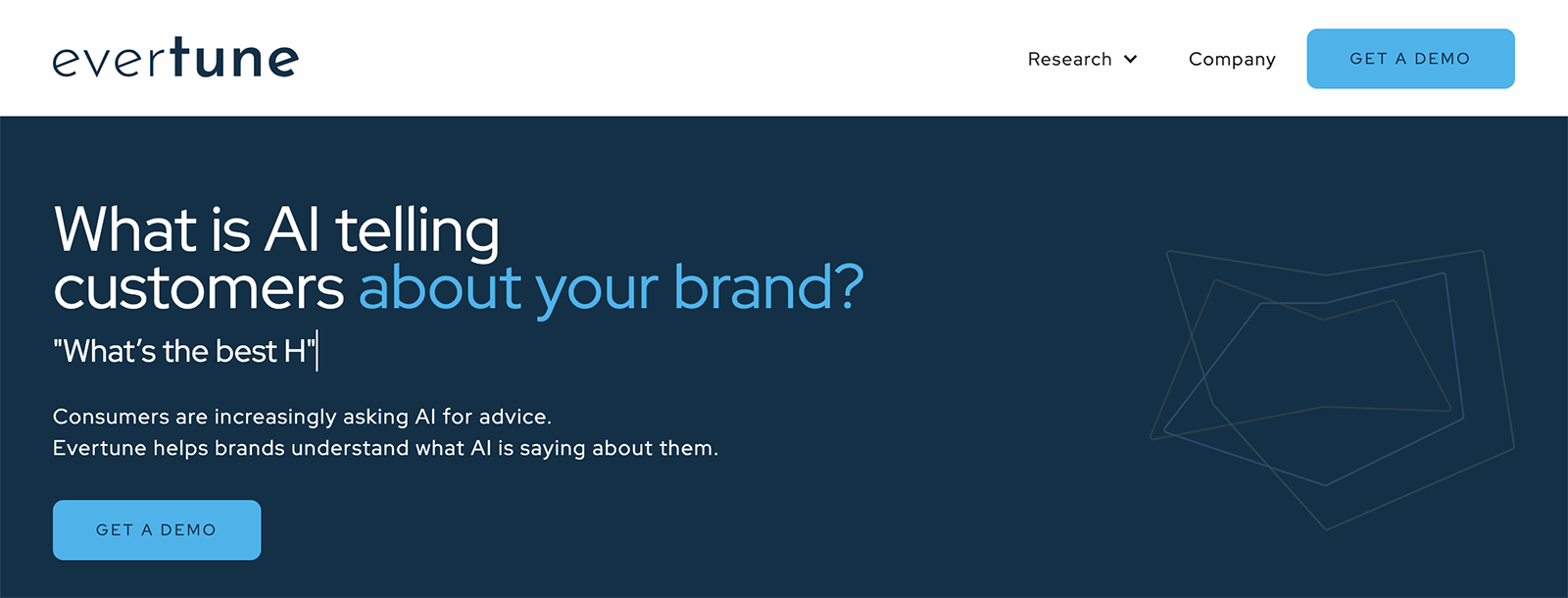
Evertune is an AI brand monitoring platform that helps companies understand how LLMs represent them. It analyzes AI answer engine content and sentiment, providing actionable recommendations to enhance content for AI discoverability.
Key Features
- AI brand index monitors how often LLMs recommend your brand or the competition so you can see how AI bots surface your content.
- AI recommendation analysis reveals what drives AI answers, helping you understand the nature of your GEO performance or search rankings.
- Sentiment analysis shows the most common words AI agents use to describe your brand, including the corresponding sentiment.
- Content analysis compares your brand’s content to the competition so know where to scale content production to inform LLMs.
Best For
Evertune is best for companies that are concerned about how AI tools perceive them for brand safety and visibility purposes. Based on Evertune’s brand index, the platform is geared toward automotive, finance, healthcare, and B2B software companies.
Pros and Cons
Pros: A focused brand-index approach with strong sentiment analysis for brand safety teams. Cons: It’s monitoring-only with no optimization or content tooling, and the lack of public pricing makes it hard to compare against the rest of this list.
Pricing
Evertune doesn’t have publicly available pricing.
14. Bluefish
GEO score: 49.0/100
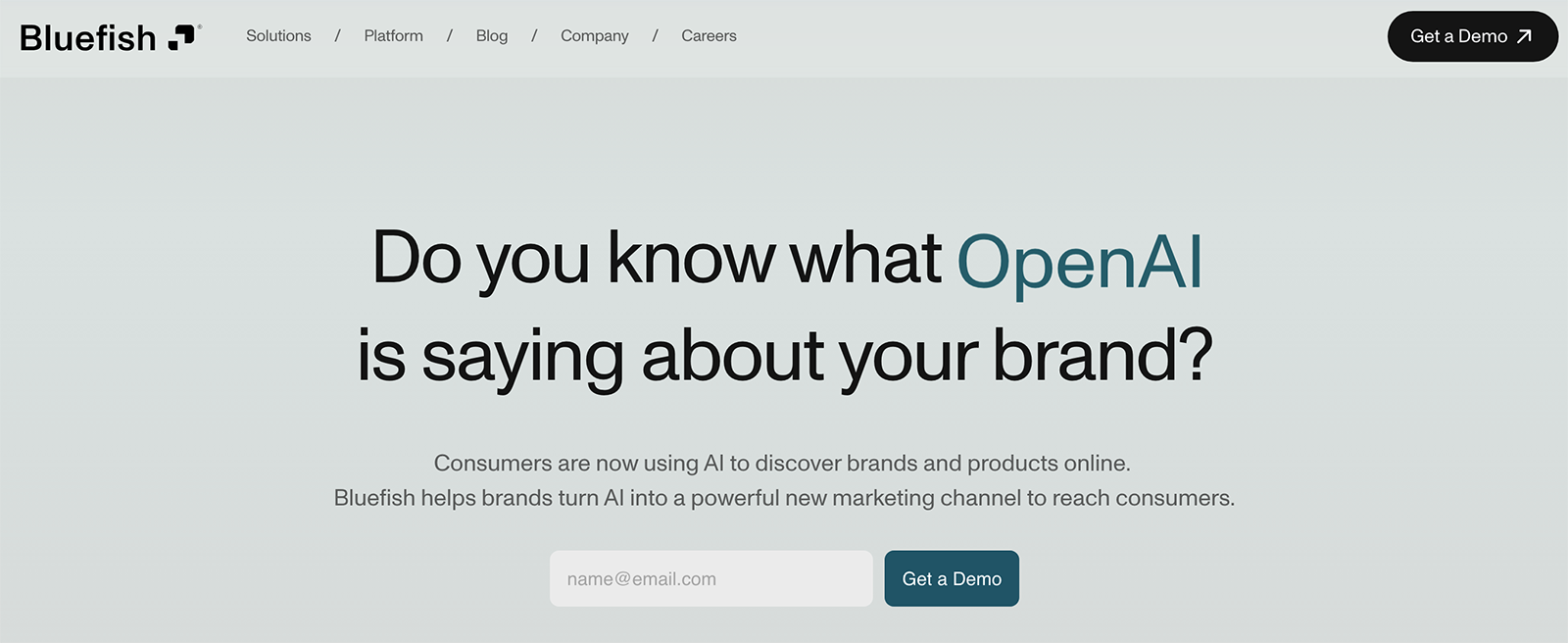
Bluefish is an AI marketing suite that turns AI search engines into a marketing channel. It gives brands control over their GEO performance, with tools for managing brand safety, optimizing content for large language models (LLMs), and running targeted AI ad campaigns.
Key Features
- AI monitoring provides insights into how AI chatbots perceive and present your brand to customers, measuring metrics like accuracy and sentiment over time.
- AI marketing agents represent your brand and engage with consumers across the AI internet.
- AI ad campaigns promote your brand directly to consumers on AI search engines.
Best For
Bluefish is best for mid-market and enterprise organizations that need to protect their brand equity and manage how AI bots view them. It’s designed for brands that want to proactively shape their GEO presence and maintain consistent positioning as AI tools become a primary information source.
Pros and Cons
Pros: A distinctive brand-safety angle plus AI ad campaigns, which no pure monitoring tool offers. Cons: It’s in a closed pilot with no public pricing or self-serve access, so most teams can’t evaluate it, let alone buy it.
Pricing
Bluefish is in a closed pilot program and doesn’t have publicly available pricing.
15. HubSpot AI Search Grader
GEO score: 46.5/100
HubSpot’s AI Search Grader is a free tool that gives marketers an easy way to understand how their brand appears in AI-generated search results. It scans engines like ChatGPT, Perplexity, and Gemini to evaluate how often your brand is mentioned, the tone of those mentions, and how you stack up against competitors.
Key Features
- Brand visibility scoring shows how frequently your brand appears in AI search results across major platforms.
- Sentiment analysis reveals whether AI engines describe your brand positively, negatively, or neutrally.
- Competitive comparison lets you benchmark your brand’s AI visibility against competitors.
- Actionable recommendations suggest improvements based on your current visibility gaps.
Best For
HubSpot AI Search Grader is best for teams just getting started with GEO who want a baseline assessment before investing in a full platform. It’s an excellent entry point for marketers unfamiliar with AI search optimization who want to understand the landscape without commitment.
Pros and Cons
Pros: Free, instant, and a genuinely useful baseline before you spend money on the category. Cons: It’s a one-time snapshot across three engines rather than continuous monitoring, with no citation source data and no way to track change over time.
Pricing
HubSpot AI Search Grader is completely free.
Frequently Asked Questions
What is GEO?
GEO (Generative Engine Optimization) is the practice of optimizing your content and brand presence so AI engines like ChatGPT, Perplexity, Gemini, and Google AI Mode mention and cite you in their generated answers. Where SEO targets a ranked list of links, GEO targets the single synthesized answer an AI engine writes. Success is binary: either you’re in the answer or you’re invisible, which is why measurement tools have become the foundation of every serious GEO program.
How is GEO different from SEO?
SEO optimizes for clicks from ranked search results using keywords, backlinks, and technical signals. GEO optimizes for citations inside AI-generated answers, which depend on how large language models read, interpret, and trust your content. The two don’t translate cleanly: Kevin Indig’s correlation analysis of 7,000 citations across 1,600 URLs found that domain rating and backlinks have weak correlations with AI citation. You’ll likely need both disciplines, but winning one doesn’t win the other.
Which AI engines should I track?
Start with ChatGPT, since it has the largest user base, then add Google AI Overviews and AI Mode, Perplexity, Gemini, and Microsoft Copilot based on where your customers actually are. B2B brands should also watch Claude. Don’t assume visibility transfers between engines: Profound’s analysis of 10,000 prompts found ChatGPT generates 91% unique fanout queries while Perplexity keeps 88% overlap with the original prompt, so the same content performs very differently across engines.
How long until I see citations?
Faster than most people expect. Profound tracked roughly 900 newly published marketing pages and found the median time to first citation by ChatGPT or Claude is 6.81 days, with 90% of pages cited within 37 days. That number is also the case for monitoring tools: without one, you have no idea whether your new page got cited in week one or never got cited at all. If a page is still uncited past the 37-day mark, the cause is usually technical, like robots.txt rules or crawl blocks keeping AI bots out.
Do I need a GEO tool if I use Semrush?
Semrush’s AI Visibility Toolkit costs $99 per month per domain, plus $60 per month for each additional 50 prompts, and it’s a reasonable starting point if you already pay for Semrush. Dedicated GEO platforms go deeper: AI crawler analytics, real user prompt volume data, more engines tracked, and optimization workflows. If AI search is a primary channel for your business rather than a side experiment, a purpose-built tool earns its cost. If you’re still testing the channel, start with the toolkit and upgrade when the data proves the opportunity.
What’s the cheapest GEO tool?
HubSpot AI Search Grader is completely free, and Gumshoe is free during its public beta. Among paid tools, Rankscale starts at $20 per month, Otterly at $29 per month, and Writesonic at $49 per month. Free tools give you a snapshot; the budget paid tiers add continuous monitoring with prompt limits sized for a solo marketer or small team.
Get Started With Profound’s GEO Tracking
The shift toward AI-driven search creates a substantial opportunity for brands to improve visibility and take control of how they’re represented. To capture it, you need the right GEO tracking tool.
Curious how Profound fits your use case? Get a demo of Profound and a custom report of your brand’s visibility.
More Profound Comparisons
Want to see how Profound compares to specific competitors? Check out these in-depth comparisons:
- Profound vs AthenaHQ - Enterprise AI visibility comparison
- Profound vs AirOps - Three-dimensional data vs workflow automation